
Evergreen private equity: A quiet revolution
Background
For much of the last forty years, allocating to private equity was like buying an exclusive off-plan property. You commit your capital before the structure exists and wait for funds to be drawn down while the portfolio manager (general partner, or GP) constructs the portfolio. You wait patiently for the project to be completed and produce revenues, which takes several years.
While historically rewarding, private equity was typically available only to institutional investors with a large amount of initial capital and a long-term horizon.
The emergence of open-ended funds (also called evergreen or perpetual funds) in recent years changed all that. Investors no longer require substantial minimum investments, and there is more optionality for liquidity beyond the typical 10-year fund term. Furthermore, on subscription, investors could gain exposure to a portfolio of existing invested assets.
To continue the real estate analogy, this is akin to purchasing an already constructed apartment.
Evergreen funds offer several features, explaining why these funds are now considered a core channel through which private markets can be accessed for certain types of investors, particularly those who are newer to the asset class.
The big picture
Pitchbook estimates that global evergreen assets under management (AUM) currently sits at around USD3.2 trillion and projects this to grow at a CAGR of 10.2 per cent to USD5.2 trillion by 20301.
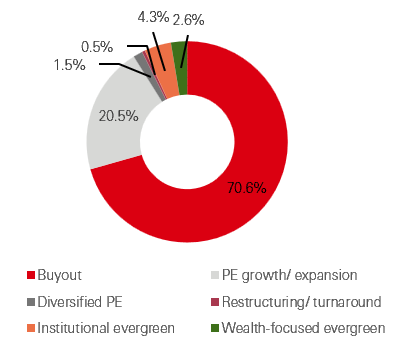
Private equity evergreen AUM is expected to grow from the current USD250 billion to USD610 billion by 2030. Institutional and wealth-focussed evergreen funds are expected to constitute almost 7 per cent of private equity AUM by 20302.
What is driving these capital flows from private wealth and institutional investors?
Figure 1: Share of base-case 2030 private equity AUM forecast by sub-strategy1
Click the image to enlarge
Source: ‘2030 Private Market Horizons’, Pitchbook (May 2026)
Evaluating the features of evergreen funds
Mitigating the J-curve effect
The first three or so years of some closed-ended private equity funds have a familiar profile. As capital is committed, fees are accrued, and deals are made generating returns. Reported performance traces a descent before rising into positive territory after four or so years – the familiar J-curve pattern.
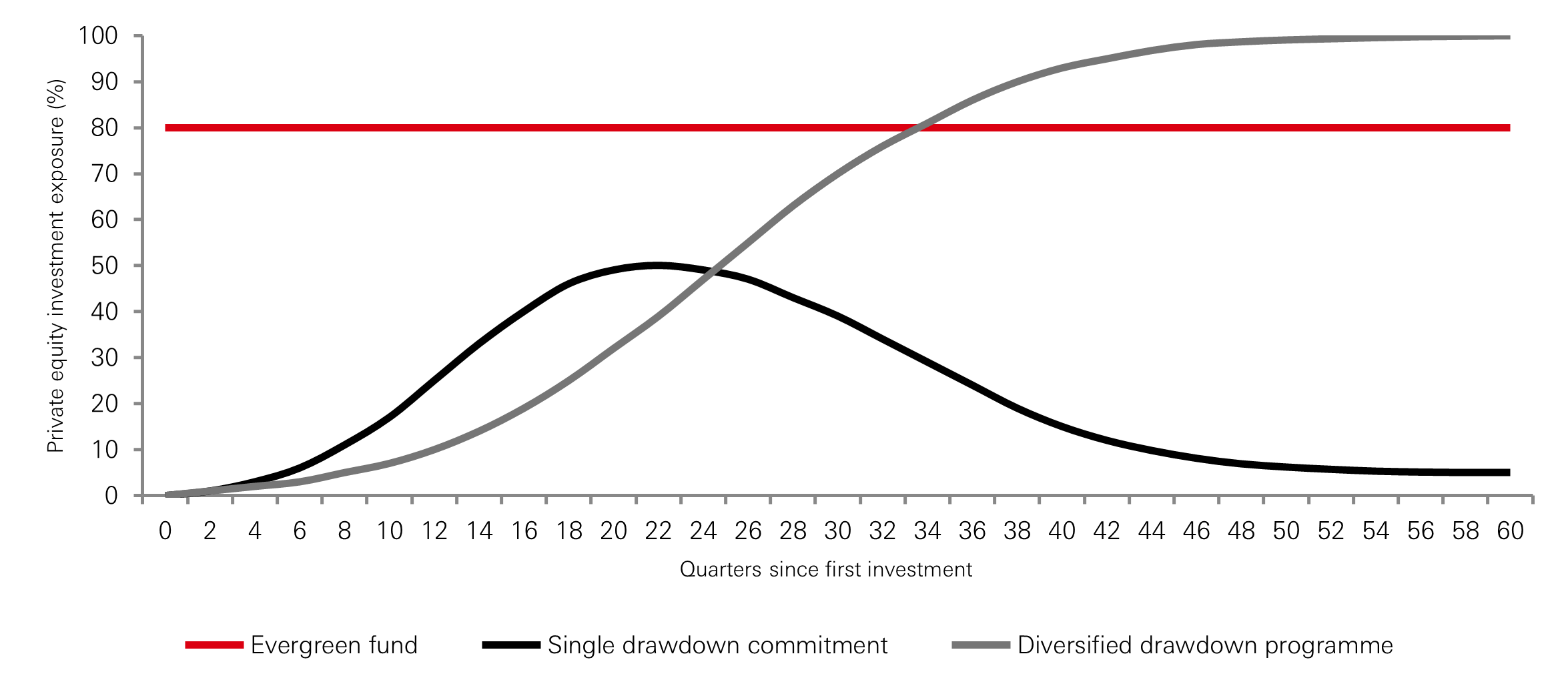
Open-ended funds can avoid the J-curve almost entirely by investing in a mature, diversified portfolio of companies, many of which are deep into their value-creation phase. Investors don’t have to wait for a manager to source deals; they can gain day-one exposure to a fully invested, diversified portfolio, with no multi-year drawdown period or pacing risk.
Figure 2: Avoiding the J-curve
Click the image to enlarge
Source: HarbourVest Partners (2025)
The power of compounding
Einstein called compounding the eighth wonder of the world for good reason. Generating earnings on an asset's reinvested earnings, or ‘interest on interest’, can allow for exponential growth over time.
Evergreen funds are designed to harness this effect more continuously. As distributions are realised, proceeds can be recycled into new opportunities, helping to reduce cash drag and potentially smoothing the J-curve by keeping capital working rather than sitting idle.
By contrast, closed-ended funds typically return distributions to investors, which can create reinvestment timing decisions and requires more active cashflow planning to maintain target exposure.
That said, we retain our conviction in closed-ended structures. In many private market strategies, they can offer the clearest, most ‘undiluted’ exposure to a defined vintage and portfolio construction and have historically been a robust route to potentially attractive long-term outcomes. Ultimately, the right vehicle depends on the client’s objectives, governance, liquidity preferences, and experience with the asset class.
For clients newer to private markets, or those who value a more automatic reinvestment mechanism, open-ended structures can be a practical way to stay consistently invested and benefit from compounding with less ongoing reinvestment administration.
Liquidity: A nuanced topic
The first open-ended funds invested in private credit. This is logical – the periodic cashflows associated with private credit are a natural fit for the open-ended nature of funds.
However, recent events have sparked concerns over the open-ended model for private assets, with some managers gating their funds following significant redemption requests in the wake of negative news flow around private credit.
These events have shined a spotlight on the structural mismatch between illiquid assets and the promise of periodic liquidity. Private credit portfolios consist of illiquid loan portfolios and private equity portfolios are collections of illiquid companies held for years. On the surface, these are not ideal assets for liquidity.
The optionality for liquidity across open-ended structures is made possible through the inclusion of a liquidity sleeve. The investment objective and target return of these funds are fundamentally driven by the illiquidity premium associated with the underlying assets. In some instances, the investment type (e.g. secondaries or co-investments) may also be better aligned to increased optionality for liquidity.
Investors typically have quarterly or semi-annual windows to redeem, with redemptions usually capped at 5 per cent of NAV per quarter, supported by a10-20 per cent liquidity sleeve held by the manager.
For private wealth investors and institutions managing long-dated objectives, this liquidity may be used to facilitate rebalancing, tactical allocation, and intergenerational planning without the need of a forced sale or the delay of arranging a sale.
Investors must carefully assess all liquidity terms prior to investment. This includes redemption gates, lockups, and liquidity sleeves to ensure they are calibrated to the underlying asset profile, and the investor’s liquidity aims and goals. The upside to capped, quarterly liquidity is the potential to achieve attractive compounded long-term performance.
Finally, a word about redemption restrictions during times of market stress. Although the ‘gating’3 of open-ended funds has garnered headlines, this should be viewed as a safety mechanism. Such features protect the value of assets for remaining investors, avoid the need for GPs to become forced sellers, and ensure functioning market operations during times of high volatility.
Restricting mass withdrawals during periods of market stress is a necessary component of a well-functioning evergreen fund.
Operational simplicity
Evergreen funds are generally more straightforward to manage operationally with a single subscription as capital is committed and deployed at once. The manager is responsible for management of cashflows.
Room for significant growth
Despite these multiple benefits, evergreen private equity remains somewhat underpenetrated, with allocations to evergreen private equity remaining lower than in credit and real estate.
Private equity accounts for roughly half of global private capital AUM4. Yet, in the US, it only makes up c11 per cent of the evergreen fund universe (USD57 billion of USD535 billion)5.
The structural opportunity for evergreen private equity is that it is underrepresented relative to the broader private markets ecosystem. As investor awareness grows and confidence builds, evergreen private equity is well positioned to capture flows and opportunities.
Key investor considerations
While the evergreen model can be an attractive route to access private equity, there are key considerations that should be factored in prior to investment:
- Investors should understand the liquidity profile of the fund and accept that private equity is not inherently designed for liquidity. This transparency can help investors appreciate the long-duration nature of the asset class and the associated benefits.
- In all private markets, manager selection and portfolio construction are critical. Recent credit stress has been impacting disproportionately on lower-quality and less-diversified portfolios. Focussing on the best managers means investors can gain exposure to attractive companies that can perform in even challenging market environments.
- Investors should objectively analyse the manager’s valuation processes, as this impacts directly on pricing and returns.
HSBC’s edge in evergreen private equity
At HSBC Asset Management (AM) Alternatives, we offer comprehensive and diversified private markets investment solutions, drawing on 35 years of private markets expertise and 30 years of experience managing open-ended funds.
Our access, deal flow, and experience powers our sourcing engine. Our private markets investment expertise spans Europe, US, and Asia markets, and we have a proven track record across primaries, secondaries, and co-investments.
HSBC AM Alternatives’ market network, platform scale, and brand power creates privileged access to an existing portfolio and pipeline of private equity opportunities with market-leading GPs.
Our diversified, high conviction approach ensures the selection of opportunities with elite third-party managers, executed through a rigorous selection process. The fund’s institutional-style portfolio aims to provide a diversified mix of secondaries and co-investments delivering potentially compelling returns combined with lower fees6.
We invest in managers that focus on genuine operational value creation, rather than focussing on taking leverage where there is far more sensitivity to rising interest rates. Aside from diversified LP-led deals, our preference in GP-led secondaries and co-investment deals is for shorter tenors, which is beneficial in terms of portfolio construction and for generating distributions.
Our focus on the mid-market allows us to invest in attractive companies with domestic operations and customers that are less exposed to global macroeconomic and geopolitical headwinds, which have frequently weighed on investor sentiment in recent years.
Case Study
Co-leading on a secondaries deal

Click the image to enlarge
Enterprises are increasingly prioritising real-time data infrastructure to support more data-intensive and AI-driven architecture.
Solace Systems, a mission-critical real-time data distribution and event-streaming infrastructure platform, is at the cutting edge of this trend. Solace is well-positioned for accelerated expansion as it helps enterprises capitalise on the transformative use of real-time data as a foundation to realise the potential of AI.
HSBC AM Alternatives recently co-led a single asset continuation vehicle7 alongside a GP in Solace. The deal demonstrates HSBC AM Alternatives’ ability to underwrite complex opportunities at pace and scale, whilst navigating multi-faceted secondary structuring.
While this deal highlights our ability to lead on secondary transactions, we are free to consider other deals where we do not lead, which translates into more deal flow opportunities than some other specialist secondary managers.
Conclusion: Taking a holistic approach
Open-ended evergreen private equity can offer distinct benefits for certain types of investors, including immediate capital deployment, automatic compounding of returns, calibrated liquidity, and a single subscription structure for operational simplicity.
However, the traditional closed-ended drawdown model should not be overlooked. In our view, closed-ended funds remain the best way for an investor to gain undiluted exposure to the asset class. Open-ended and closed-ended funds can complement each other by balancing liquidity, risk and return potential within a portfolio.
Whilst open-ended evergreen funds can provide more flexibility allowing investors periodic access to their capital, closed-ended structures can allow access to top-performing managers across vintages.
By utilising both, investors can achieve a well-rounded portfolio that maintains liquidity, efficiency, and simplicity, whilst also capturing long-term growth potential.
1 The Compound Annual Growth Rate (CAGR) measures the mean annual growth rate of an investment or business metric over a specified period longer than one year, assuming the investment compounded over that time.
2 ‘2030 Private Market Horizons’, Pitchbook (May 2026)
3 Gating is the temporary restriction or suspension of investor withdrawals.
4 ‘Private Markets in 2030’, Preqin (2025)
5 ‘Q1 2026 US Evergreen Fund Landscape’, Pitchbook (May 2026)
6 Lower fees in comparison to a portfolio of primary funds.
7 Continuation vehicles (CVs) are private equity structures used by GPs to transfer high-performing assets from an aging fund to a new vehicle, extending the holding period and providing liquidity options to existing investors.
The views expressed in this document are held at the time of preparation and are subject to change without notice.
Any forecast, projection or target where provided is indicative only and is not guaranteed in any way. HSBC Asset Management accepts no liability for any failure to meet such forecast, projection, or target. Diversification does not ensure a profit or protect against loss. Past performance does not predict future returns. For informational purposes only and should not be construed as a recommendation to invest in the specific country, product, strategy, sector, or security. Index returns assume reinvestment of all distributions and do not reflect fees or expenses. You cannot invest directly in an index. Any views expressed are held at the time of preparation and are subject to change without notice.
Key risks
- Alternatives risk: There are additional risks associated with specific alternative investments within the portfolios; these investments may be less readily reliable than others and it may therefore be difficult to sell in a timely manner at a reasonable price or to obtain reliable information about their value; there may also be greater potential for significant price movements.
- Equity risk: Portfolios that invest in securities listed on a stock exchange or market could be affected by general changes in the stock market. The value of investments can go down as well as up due to equity markets movements.
- Interest rate risk: As interest rates rise debt securities will fall in value. The value of debt is inversely proportional to interest rate movements.
- Counterparty risk: The possibility that the counterparty to a transaction may be unwilling or unable to meet its obligations.
- Derivatives risk: Derivatives can behave unexpectedly. The pricing and volatility of many derivatives may diverge from strictly reflecting the pricing or volatility of their underlying reference(s), instrument or asset.
- Emerging markets risk: Emerging particularly markets are less established, and often more volatile, than developed markets and involve higher risks, market, liquidity and currency risks.
- Exchange rate risk: Changes in currency exchange rates could reduce or increase investment gains or investment losses, in some cases significantly.
- Investment leverage risk: Investment leverage occurs when the economic exposure is greater than the amount invested, such as when derivatives are used. A Fund that employs leverage may experience greater gains and/or losses due to the amplification effect from a movement in the price of the reference source.
- Liquidity risk: Liquidity risk is the risk that a Fund may encounter difficulties meeting its obligations in respect of financial liabilities that are settled by delivering cash or other financial assets, thereby compromising existing or remaining investors.
- Operational risk: Operational risks may subject the Fund to errors affecting transactions, valuation, accounting, and financial reporting, among other things.
- Style risk: Different investment styles typically go in and out of favour depending on market conditions and investor sentiment.
- Model risk: Model risk occurs when a financial model used in the portfolio management or valuation processes does not perform the tasks or capture the risks it was designed to. It is considered a subset of operational risk, as model risk mostly affects the portfolio that uses the model.
Important information
For Professional Clients and intermediaries within countries and territories set out below; and for Institutional Investors and Financial Advisors in the US. This document should not be distributed to or relied upon by Retail clients/investors.
The value of investments and the income from them can go down as well as up and investors may not get back the amount originally invested. The performance figures contained in this document relate to past performance, which should not be seen as an indication of future returns. Future returns will depend, inter alia, on market conditions, investment manager’s skill, risk level and fees. Where overseas investments are held the rate of currency exchange may cause the value of such investments to go down as well as up. Investments in emerging markets are by their nature higher risk and potentially more volatile than those inherent in some established markets. Economies in emerging markets generally are heavily dependent upon international trade and, accordingly, have been and may continue to be affected adversely by trade barriers, exchange controls, managed adjustments in relative currency values and other protectionist measures imposed or negotiated by the countries and territories with which they trade. These economies also have been and may continue to be affected adversely by economic conditions in the countries and territories in which they trade.
The contents of this document may not be reproduced or further distributed to any person or entity, whether in whole or in part, for any purpose. All non-authorised reproduction or use of this document will be the responsibility of the user and may lead to legal proceedings. The material contained in this document is for general information purposes only and does not constitute advice or a recommendation to buy or sell investments. Some of the statements contained in this document may be considered forward looking statements which provide current expectations or forecasts of future events. Such forward looking statements are not guarantees of future performance or events and involve risks and uncertainties. Actual results may differ materially from those described in such forward-looking statements as a result of various factors. We do not undertake any obligation to update the forward-looking statements contained herein, or to update the reasons why actual results could differ from those projected in the forward-looking statements. This document has no contractual value and is not by any means intended as a solicitation, nor a recommendation for the purchase or sale of any financial instrument in any jurisdiction in which such an offer is not lawful. The views and opinions expressed herein are those of HSBC Asset Management at the time of preparation and are subject to change at any time. These views may not necessarily indicate current portfolios' composition. Individual portfolios managed by HSBC Asset Management primarily reflect individual clients' objectives, risk preferences, time horizon, and market liquidity. Foreign and emerging markets: investments in foreign markets involve risks such as currency rate fluctuations, potential differences in accounting and taxation policies, as well as possible political, economic, and market risks. These risks are heightened for investments in emerging markets which are also subject to greater illiquidity and volatility than developed foreign markets. This commentary is for information purposes only. It is a marketing communication and does not constitute investment advice or a recommendation to any reader of this content to buy or sell investments nor should it be regarded as investment research. It has not been prepared in accordance with legal requirements designed to promote the independence of investment research and is not subject to any prohibition on dealing ahead of its dissemination. This document is not contractually binding nor are we required to provide this to you by any legislative provision.
All data from HSBC Asset Management unless otherwise specified. Any third-party information has been obtained from sources we believe to be reliable, but which we have not independently verified.
HSBC Asset Management is the brand name for the asset management business of HSBC Group, which includes the investment activities that may be provided through our local regulated entities. HSBC Asset Management is a group of companies in many countries and territories throughout the world that are engaged in investment advisory and fund management activities, which are ultimately owned by HSBC Holdings Plc. (HSBC Group).
- In Australia, this document is issued by HSBC Bank Australia Limited ABN 48 006 434 162, AFSL 232595, for HSBC Global Asset Management (Hong Kong) Limited ARBN 132 834 149 and HSBC Global Asset Management (UK) Limited ARBN 633 929 718. This document is for institutional investors only and is not available for distribution to retail clients (as defined under the Corporations Act). HSBC Global Asset Management (Hong Kong) Limited and HSBC Global Asset Management (UK) Limited are exempt from the requirement to hold an Australian financial services license under the Corporations Act in respect of the financial services they provide. HSBC Global Asset Management (Hong Kong) Limited is regulated by the Securities and Futures Commission of Hong Kong under the Hong Kong laws, which differ from Australian laws. HSBC Global Asset Management (UK) Limited is regulated by the Financial Conduct Authority of the United Kingdom and, for the avoidance of doubt, includes the Financial Services Authority of the United Kingdom as it was previously known before 1 April 2013, under the laws of the United Kingdom, which differ from Australian laws;
- In Bermuda, this document is issued by HSBC Global Asset Management (Bermuda) Limited, of 37 Front Street, Hamilton, Bermuda which is licensed to conduct investment business by the Bermuda Monetary Authority;
- In France, Belgium, Netherlands, Luxembourg, Portugal, Greece, Finland, Norway, Denmark, Spain and Sweden this document is issued by HSBC Global Asset Management (France), a Portfolio Management Company authorised by the French regulatory authority AMF (no. GP99026);
- In Germany, this document is issued by HSBC Global Asset Management (Deutschland) GmbH which is regulated by BaFin (German clients) respective by the Austrian Financial Market Supervision FMA (Austrian clients);
- In Hong Kong, this document is issued by HSBC Global Asset Management (Hong Kong) Limited, which is regulated by the Securities and Futures Commission. This content has not been reviewed by the Securities and Futures Commission;
- In India, this document is issued by HSBC Asset Management (India) Pvt Ltd. which is regulated by the Securities and Exchange Board of India;
- In Italy, this document is issued by HSBC Global Asset Management (France), a Portfolio Management Company authorised by the French regulatory authority AMF (no. GP99026), through its Italian branch, regulated by Banca d’Italia and Commissione Nazionale per le Società e la Borsa (Consob);
- In Japan, this document is issued by HSBC Asset Management (Japan) Ltd (JRN 3010001124868), regulated by the Financial Services Agency;
- In Malta, this document is issued by HSBC Global Asset Management (Malta) Limited which is regulated and licensed to conduct Investment Services by the Malta Financial Services Authority under the Investment Services Act;
- In Mexico, this document is issued by HSBC Global Asset Management (Mexico), SA de CV, Sociedad Operadora de Fondos de Inversión, Grupo Financiero HSBC which is regulated by Comisión Nacional Bancaria y de Valores;
- In the United Arab Emirates, this document is issued by HSBC Investment Funds (Luxembourg) S.A. – Dubai Branch (Level 20, HSBC Tower, PO Box 66, Downtown Dubai, United Arab Emirates) regulated by the Capital Market Authority (CMA) in the UAE to conduct investment fund management, portfolios management, fund administration activities (CMA Category 2 license No.20200000336) and promotion activities (CMA Category 5 license No.20200000327).
- In the United Arab Emirates, this document is issued by HSBC Global Asset Management MENA, a unit within HSBC Bank Middle East Limited, U.A.E Branch, PO Box 66 Dubai, UAE, regulated by the Central Bank of the U.A.E. and the Capital Market Authority in the UAE under CMA license number 602004 for the purpose of this promotion and lead regulated by the Dubai Financial Services Authority. HSBC Bank Middle East Limited is a member of the HSBC Group and HSBC Global Asset Management MENA are marketing the relevant product only in a sub-distributing capacity on a principal-to-principal basis. HSBC Global Asset Management MENA may not be licensed under the laws of the recipient’s country of residence and therefore may not be subject to supervision of the local regulator in the recipient’s country of residence. One of more of the products and services of the manufacturer may not have been approved by or registered with the local regulator and the assets may be booked outside of the recipient’s country of residence.
- In Singapore, this document is issued by HSBC Global Asset Management (Singapore) Limited, which is regulated by the Monetary Authority of Singapore. The content in the document/video has not been reviewed by the Monetary Authority of Singapore;
- In Switzerland, this document is issued by HSBC Global Asset Management (Switzerland) AG. This document is intended for professional investor use only. For opting in and opting out according to FinSA, please refer to our website; if you wish to change your client categorization, please inform us. HSBC Global Asset Management (Switzerland) AG having its registered office at Gartenstrasse 26, PO Box, CH-8002 Zurich has a licence as an asset manager of collective investment schemes and as a representative of foreign collective investment schemes. Disputes regarding legal claims between the Client and HSBC Global Asset Management (Switzerland) AG can be settled by an ombudsman in mediation proceedings. HSBC Global Asset Management (Switzerland) AG is affiliated to the ombudsman FINOS having its registered address at Talstrasse 20, 8001 Zurich. There are general risks associated with financial instruments, please refer to the Swiss Banking Association (“SBA”) Brochure “Risks Involved in Trading in Financial Instruments”;
- In Taiwan, this document is issued by HSBC Global Asset Management (Taiwan) Limited which is regulated by the Financial Supervisory Commission R.O.C. (Taiwan);
- In Turkiye, this document is issued by HSBC Asset Management A.S. Turkiye (AMTU) which is regulated by Capital Markets Board of Turkiye. Any information here is not intended to distribute in any jurisdiction where AMTU does not have a right to. Any views here should not be perceived as investment advice, product/service offer and/or promise of income. Information given here might not be suitable for all investors and investors should be giving their own independent decisions. The investment information, comments and advice given herein are not part of investment advice activity. Investment advice services are provided by authorized institutions to persons and entities privately by considering their risk and return preferences, whereas the comments and advice included herein are of a general nature. Therefore, they may not fit your financial situation and risk and return preferences. For this reason, making an investment decision only by relying on the information given herein may not give rise to results that fit your expectations.
- In the UK, this document is issued by HSBC Global Asset Management (UK) Limited, which is authorised and regulated by the Financial Conduct Authority;
- In the US, this document is issued by HSBC Securities (USA) Inc., an HSBC broker dealer registered in the US with the Securities and Exchange Commission under the Securities Exchange Act of 1934. HSBC Securities (USA) Inc. is also a member of NYSE/FINRA/SIPC. HSBC Securities (USA) Inc. is not authorized by or registered with any other non-US regulatory authority. The contents of this document are confidential and may not be reproduced or further distributed to any person or entity, whether in whole or in part, for any purpose without prior written permission.
- In Chile, operations by HSBC's headquarters or other offices of this bank located abroad are not subject to Chilean inspections or regulations and are not covered by warranty of the Chilean state. Obtain information about the state guarantee to deposits at your bank or on www.cmfchile.cl;
- In Colombia, HSBC Bank USA NA has an authorized representative by the Superintendencia Financiera de Colombia (SFC) whereby its activities conform to the General Legal Financial System. SFC has not reviewed the information provided to the investor. This document is for the exclusive use of institutional investors in Colombia and is not for public distribution;
- In Costa Rica, the Fund and any other products or services referenced in this document are not registered with the Superintendencia General de Valores (“SUGEVAL”) and no regulator or government authority has reviewed this document, or the merits of the products and services referenced herein. This document is directed at and intended for institutional investors only.
- In Peru, HSBC Bank USA NA has an authorized representative by the Superintendencia de Banca y Seguros in Perú whereby its activities conform to the General Legal Financial System - Law No. 26702. Funds have not been registered before the Superintendencia del Mercado de Valores (SMV) and are being placed by means of a private offer. SMV has not reviewed the information provided to the investor. This document is for the exclusive use of institutional investors in Perú and is not for public distribution;
- In Uruguay, operations by HSBC's headquarters or other offices of this bank located abroad are not subject to Uruguayan inspections or regulations and are not covered by warranty of the Uruguayan state. Further information may be obtained about the state guarantee to deposits at your bank or on www.bcu.gub.uy.
Copyright © HSBC Global Asset Management Limited 2026. All rights reserved. No part of this publication may be reproduced, stored in a retrieval system, or transmitted, on any form or by any means, electronic, mechanical, photocopying, recording, or otherwise, without the prior written permission of HSBC Asset Management.
Content ID: D074181_v.2.0; Expiry Date: 31.07.2027