
Venture capital: Investing in the age of AI
Executive summary
The generative artificial intelligence (AI) boom, catalysed by ChatGPT’s viral success, has transformed technology adoption and investment at an unprecedented pace.
- ChatGPT’s rapid adoption in late 2022 marked a pivotal moment, propelling generative AI into mainstream use and sparking unprecedented investor and enterprise enthusiasm
- The AI boom is driving massive capital expenditure in tech infrastructure, with hyperscale cloud providers and chipmakers at the centre of growth and public market gains
- Emerging trends include agentic and vertical AI, data privacy, compute efficiency, and increased regulation, signalling a multi-decade transformation across industries
The public stock performance of Nvidia and other AI companies offers a window into the scale of the AI boom. However, these are mostly indirect plays. The companies capturing public investors’ dollars are often those selling the tools and infrastructure (cloud services and chips) enabling AI, rather than new AI solutions themselves. For investors wanting to participate in AI’s growth, private markets offer a more direct way to invest in the emerging AI solution providers riding this wave.
Private market participation offers:
- Differentiated access: Through private markets, investors can access companies that are not available on stock exchanges but are central to the AI revolution. This includes the likes of Anthropic, OpenAI, Databricks, and a myriad of other promising firms
- Potential for outsized returns: While public tech stocks have delivered robust performance (e.g. Nvidia), the step-change in value when a startup goes from zero to one usually happens at the private stage. The next Google or Amazon could very well be a VC-backed company
- Portfolio diversification and innovation exposure: Adding AI-focused venture capital exposure can complement traditional portfolios. AI is likely to disrupt many incumbents, so owning a basket of innovative private companies can provide valuable portfolio diversification
Understanding the AI landscape
ChatGPT : The catalyst for the AI boom
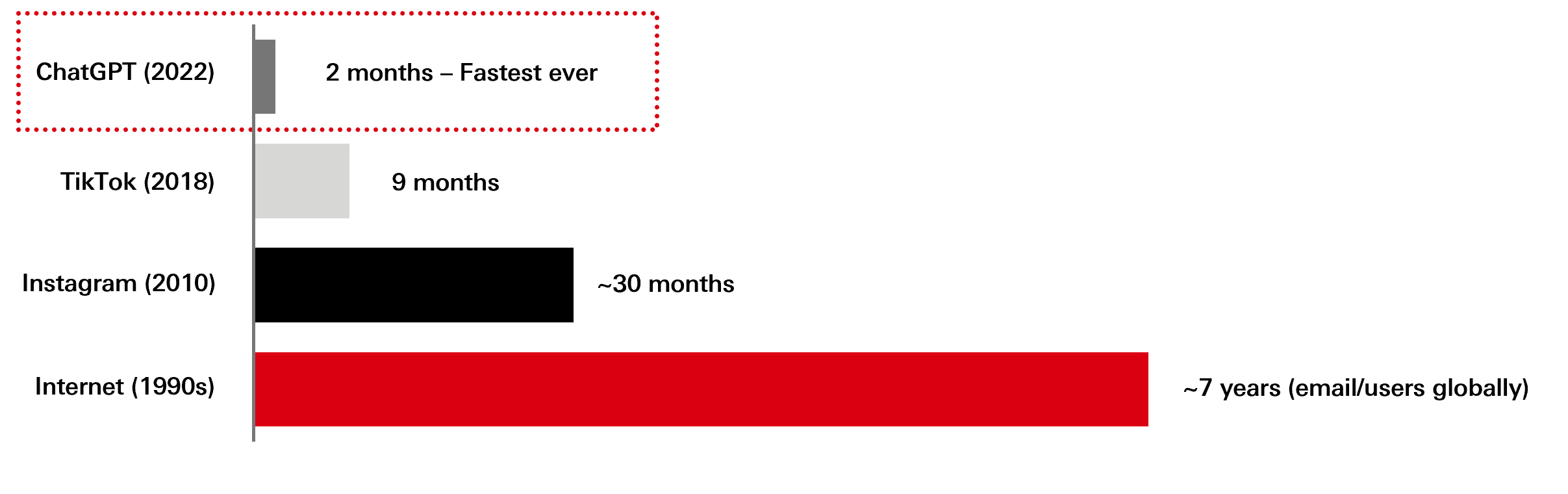
In November 2022, a simple chatbot became a global phenomenon. OpenAI’s ChatGPT, reached 100 million users in just two months—faster than any consumer app in internet history (Instagram took 2.5 years; TikTok 9 months).
This viral success marked a modern inflection point for artificial intelligence (AI). Investors and executives took notice – after decades of gradual progress, AI had a mainstream ‘killer app’. The launch of ChatGPT set off a wave of AI enthusiasm in boardrooms and markets. AI didn’t appear overnight—a convergence of capability, usability, and distribution finally brought AI into everyday use.
ChatGPT’s breakthrough demonstrated AI’s leap from lab to real world. This turning point made AI tangible for millions, sparking a global surge in interest from consumers, enterprises, and investors.
Why generative AI was a step-change
Generative AI like ChatGPT is a type of AI that creates content by learning patterns from massive datasets. It represents a step-change from prior AI waves. Earlier AI systems could detect patterns or make predictions, but they often required specialised input data and were used in narrow contexts. In contrast, ChatGPT and other generative models can create human-like text, images, or code via a simple prompt interface.
This combination of capability and accessibility was new. ChatGPT could draft an email or answer a complex question in plain language—no coding or expert knowledge required. Moreover, it was deployed through the cloud to anyone with an internet connection, unlike prior AI which might have been buried in research labs or enterprise software.
The result was that AI became broadly usable, revealing potential in creative and knowledge work, not just back-end analytics. Investors saw that generative AI could unlock entirely new markets and applications, fuelling the sense that this was qualitatively different from the last AI hype cycle.
A decade in the making
2012Deep learning 
Behind this ‘overnight’ success were years of foundational advances. Modern AI’s resurgence traces back to breakthroughs in deep learning around 2012, when neural networks started outperforming older techniques in vision and speech. |
2017Invention of transformer models 
Another leap came in 2017 with the invention of transformer models, which enabled today’s large language models by improving how AI algorithms handle language context. |
2020Large language models 
These advances laid the groundwork for GPT-3 (2020) and then ChatGPT’s debut. |
This origin story helps explain why investors are now laser-focused on AI. After a decade of incremental progress, the ChatGPT moment showed that AI is ready for prime time. Public market excitement quickly followed, but the question for investors then became: where will the most value be created in this new AI era?
The AI spending boom and public market impact
AI demand is sparking a tech spending boom
The spike in AI usage is driving an unprecedented wave of capital expenditure (capex) in the tech industry. To handle millions of AI queries and train ever-larger models, companies are pouring money into hardware and cloud infrastructure. This dynamic can be seen as an ‘AI capex flywheel’. Enterprise and consumer demand for AI-powered services fuels spending on the entire value chain—from applications to the chips that run AI models.
For example, every time a company deploys an AI feature, it triggers demand for model inference, which in turn drives consumption of cloud computing services and specialised hardware like GPUs1. These GPUs are mostly supplied by a few players (notably Nvidia), which then reinvest in more chip production and research and development.
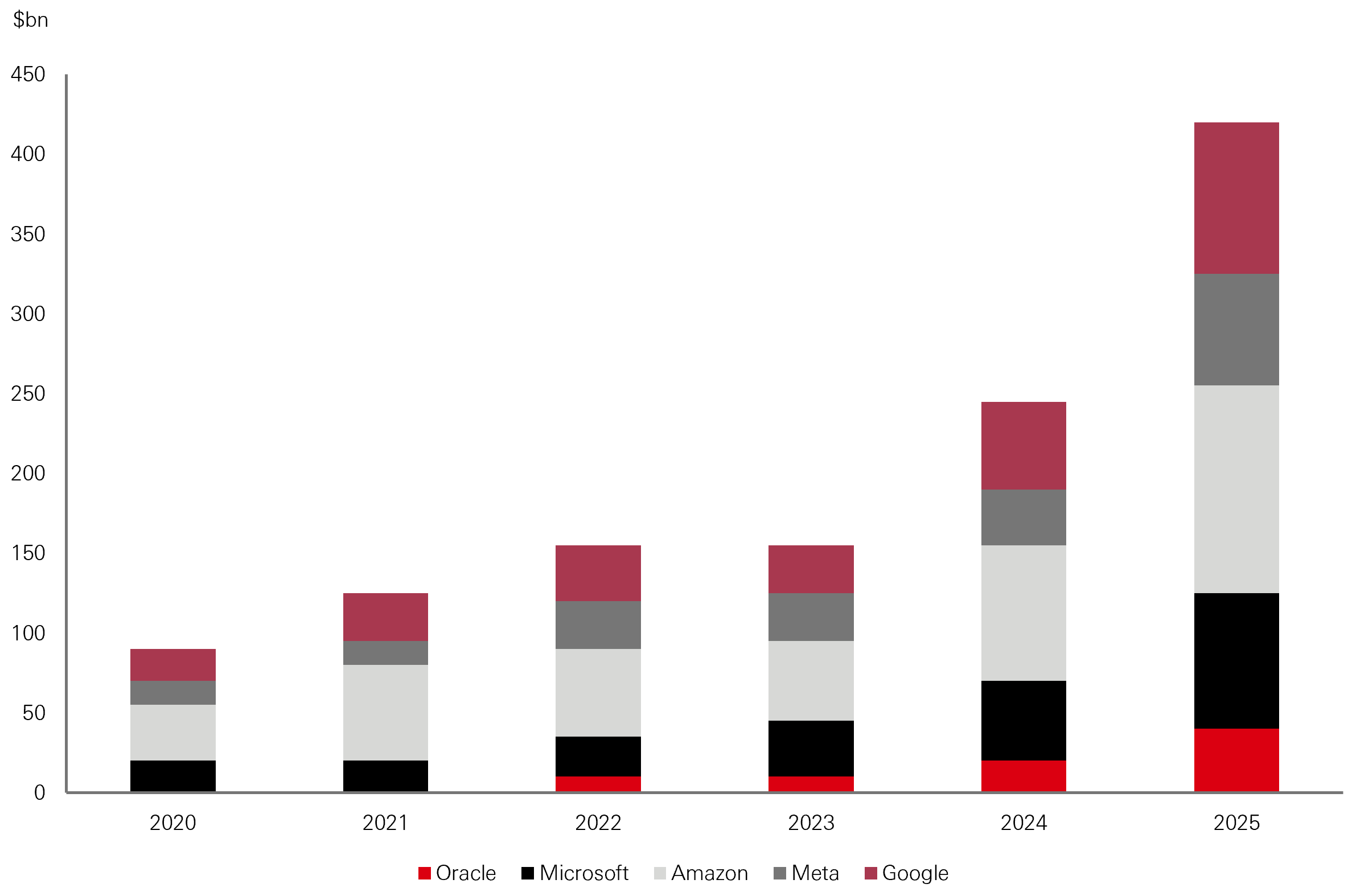
This cycle has begun to resemble a virtuous circle. As enterprises invest in AI capabilities, tech giants invest in more infrastructure to meet that demand. Hyperscale cloud providers (Amazon, Microsoft, Google, Meta) have dramatically raised their capital spending plans to build AI data centres.
The chart below shows the rising trend of hyperscaler capital expenditure since 2020.
Figure 1: Hyperscaler capex by year
Click the image to enlarge
Source: FactSet, Apollo Chief Economist (February 2026)
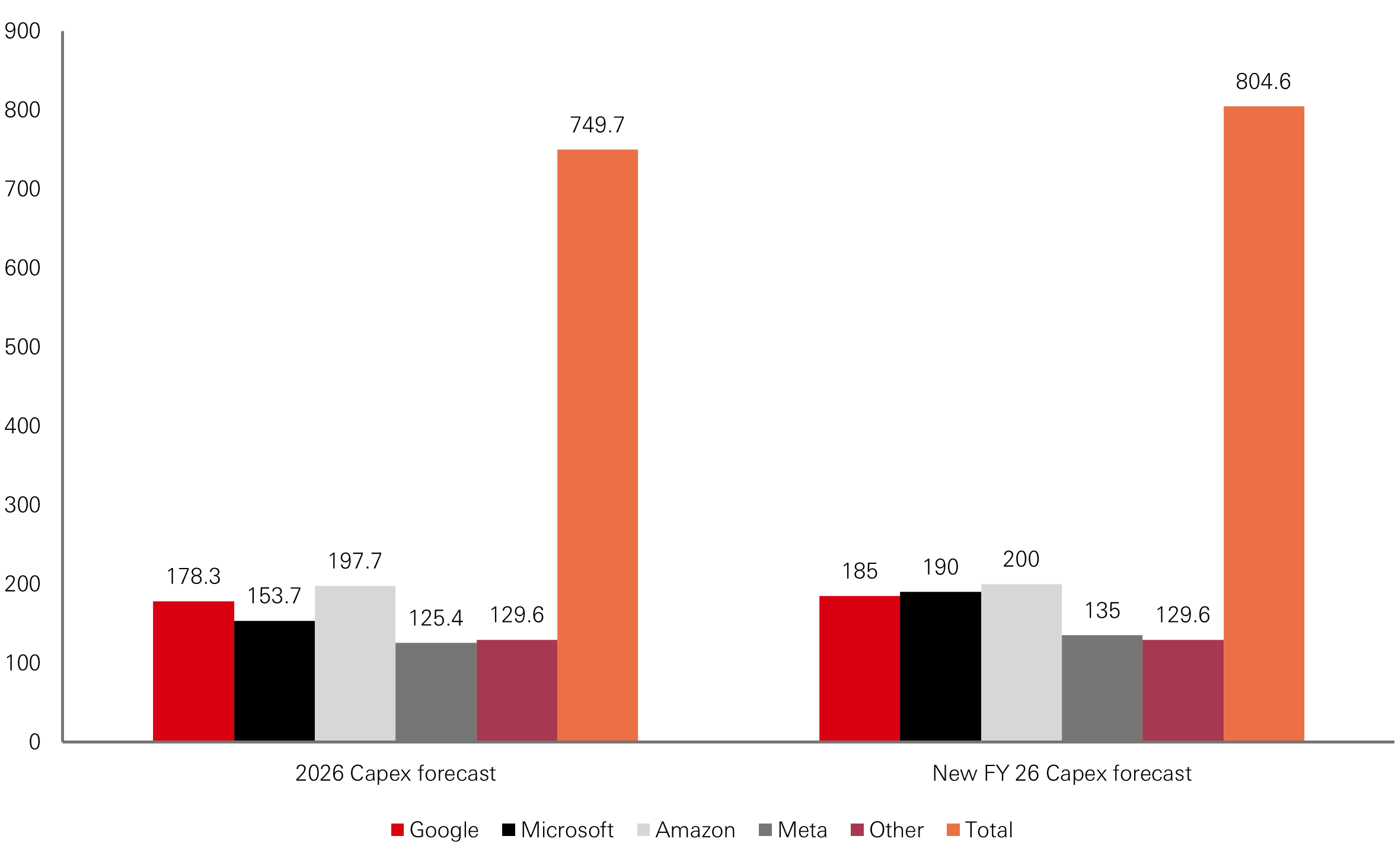
The most recent spending projections are up to USD 804.6 billion in 2026 as shown below:
Figure 2: Capex for Big Tech rises
Click the image to enlarge
Source: Bank of America (April 2026). Values are BofA estimates in USD billions.
Expectations are that capex will exceed USD1 trillion for the first time in 2027. This massive spend underpins the AI boom and highlights how public markets are indirectly exposed to AI’s growth through these capex-intensive players.
Public market proxies for AI success
While many AI innovations are coming from startups, the public markets have reacted to the AI wave. In 2023, a handful of mega-cap tech stocks – nicknamed the ‘Magnificent Seven’ – drove a disproportionate share of stock market gains on the back of AI optimism. Apple, Microsoft, Alphabet (Google), Amazon, Nvidia, Meta, and Tesla together accounted for 62 per cent of the S&P 500’s total return in 2023[6], reflecting how AI euphoria concentrated in a few big winners.
Notably, Nvidia – the leading GPU provider – became a symbol of the AI ‘picks and shovels’ play. Its chips power most advanced AI models, making Nvidia a prime beneficiary of the model-building frenzy. Investors rewarded this positioning: by mid-2025, Nvidia briefly became the first company in history to reach a USD 5 trillion market valuation2, highlighting the ‘investor frenzy around AI and cementing the view that an AI-driven tech supercycle was underway.
How does AI compare to previous tech cycles?
Adoption at unprecedented speed
By many measures, the adoption of generative AI has been faster than any previous tech cycle. We already saw how ChatGPT set records for user growth. Consider enterprise uptake. In a global 2023 survey, one-third of companies reported they were already using generative AI in at least one business function less than a year after ChatGPT debuted.
For comparison, when the internet boom started in the late 1990s, or the smartphone revolution in the late 2000s, it took several years for even 10 per cent of businesses to integrate those technologies into workflows.
Figure 3: Time to reach 100 million users
Click the image to enlarge
Sources:
'ChatGPT sets record for fastest-growing user base - analyst note', Reuters (2023)
'The digital imperative', BCG Perspectives (2015)
Funding and formation: Parallels to dot-com and cloud eras
The capital flow into AI startups has also been intense—though more targeted—compared to past cycles like the dot-com boom. In the late 1990s, internet startups were formed at a frantic pace but many lacked revenue or realistic business models.
The current AI wave shows some similar exuberance, but there are key differences. AI startups today often have real products or technical breakthroughs at their core. Many AI companies are pursuing enterprise software-like go-to-market strategies, learning from the playbooks of the cloud/SaaS era.
In 2021, global venture funding hit record highs then pulled back in 2022. Yet within that downturn, AI funding fell less and rebounded faster than other areas. By 2023, even as overall venture activity was muted, investors funnelled billions into generative AI deals, and by 2024 global AI private investment was growing again at +45 per cent year-on-year3. This pace resembles the early cloud computing boom cycle: despite the 2008–09 global financial crisis, cloud startups continued to attract capital on the back of clear long-term demand.
Hype vs. reality: Lessons from previous cycles
No tech revolution comes without hype—and eventual reality checks. The dot-com era taught investors about exuberance: many companies went public too early with inflated expectations, leading to the 2000 crash.
The lesson for AI: not every AI startup will live up to its valuation or lofty promises. There will be shakeouts, especially in crowded segments. Today’s AI landscape will similarly reward companies that achieve real adoption and defensible technology.
From infrastructure to applications
To navigate the AI market, it helps to understand the ‘AI stack’ – the layers of technology that together make AI solutions possible. This is analogous to the classic IT stack (hardware > software > user interface) but tailored to AI’s unique components. There are four key layers, shown below.
|
|
Infrastructure layer |


|
|
AI model layer |

|
|
AI tooling and data layer |

|
|
Application layer |

Emerging themes to watch
As we look ahead, several high-impact trends are emerging in the AI landscape. These will shape innovation and investment over the next decade:
- AI agents and multimodal AI4:Today’s AI assistants (like chatbots) are mostly text-based and user-driven. The future is moving toward more agentic AI – systems that can take autonomous actions on our behalf. For example, an AI agent might book your travel or manage supply chain logistics. This could revolutionise workflows: instead of single-task bots, we get AI co-workers handling complex sequences
- Verticalised and domain-specific AI: We expect a proliferation of industry-specific AI solutions. The first wave of generative AI was general purpose. The next wave is about depth: AI finely tuned for healthcare diagnostics, legal analysis, financial forecasting, industrial robotics etc. These vertical AIs combine general AI techniques with domain expertise and proprietary data. These vertical solutions could transform traditional sectors and potentially dwarf today’s horizontal SaaS5 markets
- Data, privacy, and security as differentiators: As AI systems become widespread, the importance of data quality and governance will intensify. We foresee a premium on companies that own unique data sets for training AI. Simultaneously, concerns about privacy and security are rising
- Compute efficiency and new hardware paradigms: The current AI boom is costly and energy intensive. A major trend is toward making AI more efficient: this includes model optimisation techniques as well as new hardware. We anticipate breakthroughs in specialised AI chips. Additionally, other approaches like quantum computing6, while further out, could dramatically change the AI compute landscape in 5-10 years
- Open-source vs. proprietary (and ‘sovereign AI’): A tension that will define the AI market is the balance between open-source models (e.g. LLaMA, Meta) and closed proprietary models (e.g. OpenAI/Microsoft). This debate extends to a geopolitical level: sovereign AI refers to countries (or regions) wanting their own core AI technologies. Europe, for example, has discussed the need for AI models that align with European values
- Regulation and ethical AI shaping the field: In the coming years, regulation is likely to increase. The EU’s AI Act will impose certain requirements on AI systems (transparency, risk etc.) with hefty fines for non-compliance. Trustworthy AI will be a selling point – enterprise customers (like banks) will demand evidence that an AI system is robust and fair
Over a 5–10-year horizon, we believe AI will cement itself as a general-purpose technology akin to electricity or the internet that permeates every industry. This means opportunities will be broad and continuous. AI is not a one-time theme, but a multi-decade transformation.
Why private markets are key to AI value creation
Who captures the value?
Public markets have seen trillions in market cap added to the largest tech firms on the AI narrative. Equally, we have seen private valuations for AI startups skyrocket within a year of ChatGPT’s launch. Investors in Anthropic’s early rounds, for instance, have seen marked-up values given the latest USD380 billion valuation reports, and is funding a vast expansion in computing capacity that could see its valuation rise to USD900 billion7.
In this piece, we offer evidence-based arguments for why many of AI’s biggest opportunities are being seized in the private domain.
The frontier of innovation is staying private
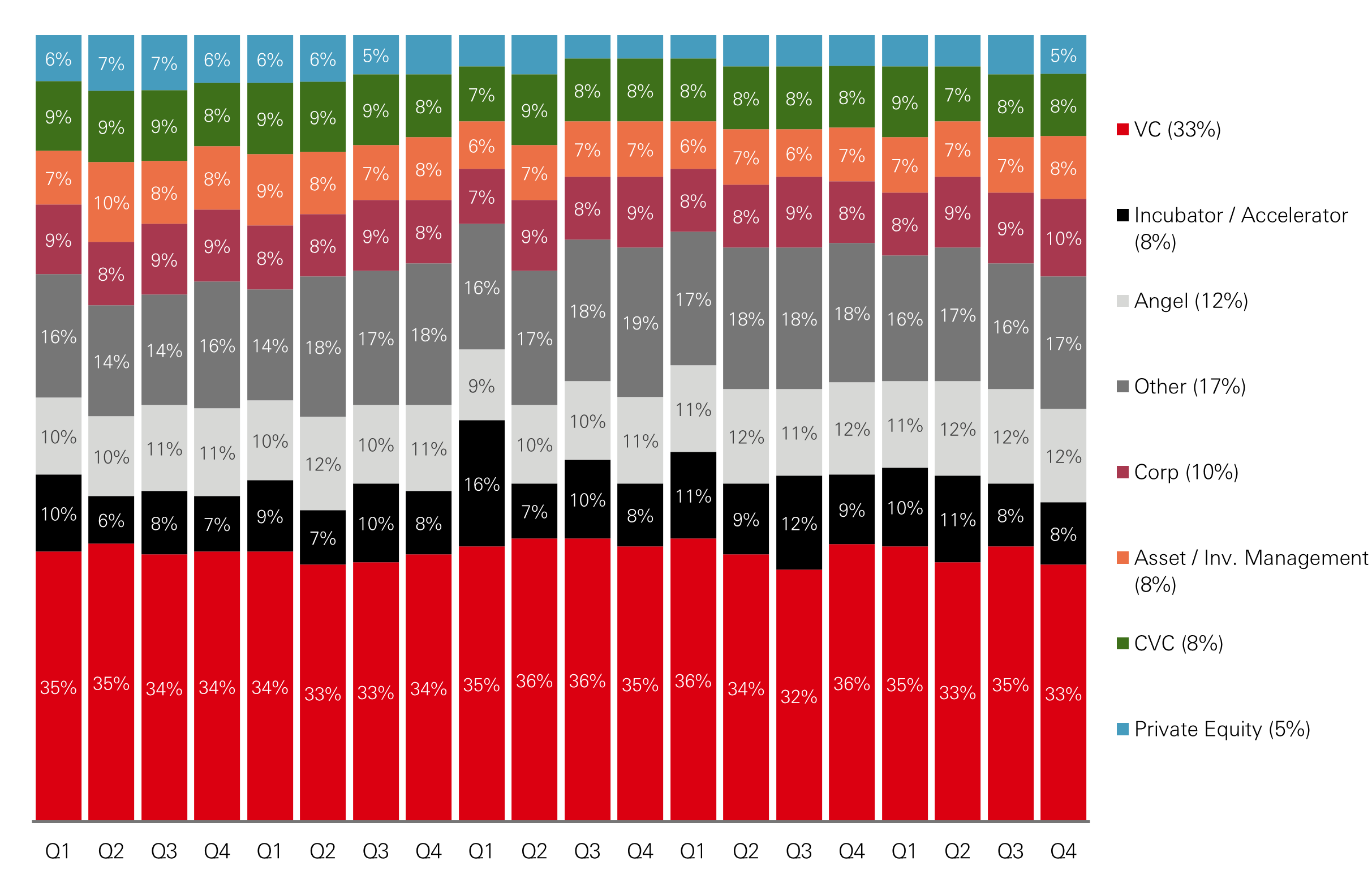
Unlike some past tech cycles where high-growth companies raced to IPO, the current generation of AI leaders is choosing to stay private longer. There are several reasons for this: ample availability of private capital, strategic advantages of focusing on R&D away from quarterly earnings pressures, and the sheer scale of investment needed. The effect is that many of AI’s most valuable early companies are private.
In Q4 2025 alone, KPMG reported that eight AI companies in the US raised USD1 billion+ funding rounds, led by Anthropic (USD15 billion). This highlights a simple truth: if you want broad exposure to cutting-edge AI ventures (from novel drug-discovery to the next ChatGPT-like platform), you need to participate in private markets.
Figure 4: Quarterly AI deals by investor group (per cent)
Source: HSBC AM Alternatives as of March 2026, unless otherwise stated.
Who captures the value?
Capturing value before the IPO
Historically, venture-backed companies have delivered a large share of their total value creation before going public – and this trend has intensified. In the 1980s–90s, a tech company might IPO within five years at a few hundred-million-dollar valuation; in the 2020s, it is common to see companies wait 8-10+ years and IPO at multi-billion-dollar valuations.
AI companies are no exception, meaning private investors can reap the upside from early growth, product-market fit, and market domination. By the time these companies potentially IPO, much of that steep growth curve has already occurred with much of the rewards reaped by private market investors.
Balancing opportunity with risk
Beneath the headline enthusiasm for AI’s transformative potential lie structural and market-specific factors that investors should weigh carefully before committing capital. We outline some key considerations below:
- Model commoditisation: As AI model improve and open-source options spread, it becomes more difficult for any single company to maintain a unique edge. The risk is that competitors catch up and squeeze profits
- GPU/Compute dependence: Most AI companies rely on a small number of chipmakers like Nvidia for processing power. Chip shortages, price rises, or export restrictions could disrupt growth plans.
- Valuation and funding risk: Many AI startups are valued on future potential, rather than current profits. If investor appetite cools, future funding rounds may be more challenging to secure or come at lower valuations.
- Regulatory uncertainty: Governments globally are still deciding how to best govern and regulate AI. New rules could increase compliance costs or restrict how companies operate.
Therefore, the key for private investors is access and diversification. Investors can create a diversified portfolio of VC funds across primary, secondary, co-investments, and fund-of-funds. For further information, please read our ‘Venture capital: Time to invest’ paper.
In the next section, we look at where new capital is flowing in the AI space and which segments appear most promising in coming years.
Current state of the AI VC market
Big picture: AI investment rebounds strongly
The past two years have seen a surge of capital into AI, despite a cautious climate for tech funding. In 2025, the OECD reported that VC investments in AI firms globally made up over half of all VC investment at USD259 billion, up from a 30 per cent share in 2022. For GenAI firms specifically, VC funding surged from about 2 per cent in 2022 to 14 per cent in 2025, or about USD35 billion.
Which sectors of AI are getting funded?
AI is not monolithic – investors are placing bets across a range of sub-sectors, as shown below.
Top investment areas in 2025 (Stanford AI Index data8)
|
|
AI infrastructure, research, and governance: USD143.2 billion invested, up from USD37.3 billion invested in 2024, a 2.8x increase. This includes companies building fundamental AI tech. The huge figure here was boosted by mega-rounds into foundation model companies (e.g. OpenAI, Anthropic, and xAI). |
|
|
Data management and processing: USD31.6 billion invested, up from USD16.6 billion invested in 2024, a 90 per cent increase. AI is only as good as the data feeding it. Startups focusing on handling the data pipeline attracted significant funding (e.g. Databricks and Crusoe). As AI adoption grows, so does the need for better data curation. |
|
|
AI x Internet of Things (AIoT): USD14.6 billion invested, up from USD0.8 billion invested in 2024, a huge 16.4x over 2024 levels. IoT is the digital world’s nervous system—billions of connected devices and sensors capturing and sharing real-time data. When AI supercharges IoT, it is transforming all kinds of industries and our everyday life. |
|
|
Healthcare AI: USD11.7 billion invested, up slightly from USD11.0 billion invested in 2024. Health and life sciences continue to be major areas for AI application, from drug discovery to AI-assisted medical imaging. Healthcare’s sizeable share of AI investment underscores not just the opportunity but also that specialised domain AI often requires dedicated startups with deep expertise (e.g. Babylon Health, and Commure). |
|
|
Other notable areas: We also see strong activity in financial services AI (fintech using AI for fraud detection, trading, underwriting), consumer AI applications (AI creative tools, personal assistants), and cross-industry enterprise AI (supply chains). |





Stage and size: From seed to mega-rounds
Many venture firms refocused their attention on AI, leading to larger seed rounds and higher valuations. At the early stage, a flood of new AI startups received funding. However, growth mega-rounds are the standout trend, comprising 73 per cent of investment value of AI VC deals in 2025 (OECD, Preqin). One reason for these mega-rounds is corporate participation. When hyperscalers invest, they can inject large sums that traditional VCs might not match alone (e.g. Amazon, Anthropic).
Geographical trends: US continues to dominate
In 2025, the US comprised 75-79 per cent of global AI VC deal value, followed by the EU (6 per cent), China (5 per cent), the UK (5 per cent), and the rest of the world (5-9 per cent)9. The dominance of the US in AI funding is clear.
China’s share of deal value has shrunk, due in part to regulatory crackdowns in China’s tech sector and geopolitical tensions.
Europe has pockets of AI excellence, with the UK leading the charge. The strict regulation in the EU is a double-edged sword; it might slow deployment but also spur a wave of trustworthy AI startups and sovereign initiatives.
Israel brings its strength in deep tech to AI (e.g. security); India and South-East Asia are nascent but growing, as huge AI app markets (e.g. fintech and healthcare).
The next section dives deeper into two emblematic companies – OpenAI and Anthropic – whose trajectories illustrate both the scale and the strategic dynamics at play in this AI cycle.
Case studies: OpenAI and Anthropic

OpenAI: A private research lab turned platform leader
OpenAI began as a research organisation in 2015, but by 2023 it had transformed into one of the most pivotal companies in AI. The launch of ChatGPT vaulted OpenAI into the global spotlight, and it quickly moved to capitalise on demand with a paid subscription (ChatGPT Plus) and extensive cloud API offerings.
By early 2024, OpenAI’s GPT-4 model was being used via API10 by thousands of companies to build AI features into their products. Microsoft’s strategic partnership was key to this scaling: Microsoft invested around USD10 billion in OpenAI11, becoming OpenAI’s exclusive cloud provider and integrating GPT models into products like Bing and Microsoft Office. This gave OpenAI both the funding and the enterprise distribution it needed to grow quickly.
By late 2025 OpenAI claimed over a million business customers for ChatGPT services, and some analysts estimate its annual revenues in the multiple billions of dollars. OpenAI’s valuation has followed suit: private market transactions in 2023 valued the company at around USD80 billion—a rare scale for a pre-IPO company.
OpenAI thus exemplifies a ‘category definer’. It created a new category and achieved rapid user and revenue growth while still privately held. For investors, OpenAI demonstrates how quickly an AI leader can emerge – and that such leaders may stay private longer, backed by mega-rounds from strategics and VCs instead of rushing to public markets.

Anthropic: Competing at the frontier with strategic backing
While OpenAI has Microsoft, Anthropic has taken a similar path with support from other tech giants. Anthropic is an AI startup founded in 2021 by former OpenAI researchers, focused on creating large language models that emphasise AI safety and reliability.
The company’s trajectory accelerated with a major partnership: Amazon agreed to invest up to USD4 billion in Anthropic in 2024, securing a minority stake and naming Amazon Web Services (AWS) as Anthropic’s primary cloud partner. AWS gained a marquee AI partner to showcase its cloud (and sell chips to), while Anthropic gained funding and guaranteed cloud infrastructure on AWS.
Anthropic’s growth accelerated sharply in late 2025 on the release of Claude Opus 4.5, its flagship advances LLM, which has helped increase adoption of Claude Code, a software tool. The company experienced another boost in growth in January 2026 on the release of Cowork, Anthropic’s agentic AI tool.
Anthropic has emerged as leader in artificial intelligence raising significant funding, with recent investment offers valuing the company at over USD900 billion12.
OpenAI’s ChatGPT chatbot still has significantly more users than Anthropic’s Claude. However, Anthropic has closed the gap by taking a more focussed product approach, which is resonating with coding users and businesses.
Anthropic trains models using a set of guiding principles (its ’constitution’), rather than human feedback alone and the company has dedicated research teams focussed on AI safety and the societal impacts of AI.
Anthropic’s story highlights that winners in this layer can gain outsized strategic value if they offer something unique. In Anthropic’s case, an innovative alternative to OpenAI with a safety-first reputation.
Partnerships signal the new AI ecosystem
Both OpenAI and Anthropic illustrate how the AI ecosystem is shaping up as a symbiotic relationship between private AI innovators and established ‘battling’ tech giants. Big cloud companies provide capital, computing hardware, and customer channels, while startups provide cutting-edge models and innovation.
In 2023, around 60 per cent of all AI startup funding went into foundation model companies like these two. They raised about USD23 billion just that year and achieved a collective private-market valuation around USD124 billion.
For investors, these figures underscore a key message: many of AI’s most valuable players (the ‘AI crown jewels’) are currently outside public markets, accessible only via private investment. To understand where the next wave of value will emerge, it is essential to look beyond the headline-grabbing model companies and explore the entire AI technology stack.
Conclusion: Public markets build; private markets innovate
AI as a multi-year transformational ‘supercycle’
In 2026, it is clear that artificial intelligence is not a passing fad but a fundamental technological shift – often likened to the advent of the internet or mobile computing. AI exhibits the hallmark of a transformative platform technology: it drives progress across many domains (from medicine to finance), rather than being isolated to a single sector.
This suggests we are still in the early innings of a long wave of AI-driven innovation and value creation. Just as the internet boom of the 1990s laid the groundwork for decades of digital business growth, the 2020s AI boom is setting the stage for enduring changes in how we work and interact with technology.
Public markets have so far reflected the infrastructure build-out and broad enthusiasm – witness trillion-plus valuations for chip and cloud companies and the stock market’s rewarding of AI adopters among Big Tech.
These public companies are indeed critical to AI, and they will capture significant value as AI becomes ubiquitous.
However, the cutting edge of AI innovation largely lies in the private realm. The most advanced models and many of the breakthrough applications and specialist tools – in other words, the new value generators – are being created by venture-funded companies. Significant value accretion in AI is happening pre-IPO. This does not diminish the role of public companies, but it means that investors restricted to public equities are only seeing the tip of the iceberg.
The AI supercycle implies a rising tide, but not all ships will rise equally – careful investment selection and diversification remain key. Private markets are the engine of AI innovation, offering direct access to the most transformative models, tools, and applications.
While public markets build the infrastructure, true value creation often happens pre-IPO. To fully capture AI’s generational opportunity, investors must look beyond public equities and participate in private markets.
Risks of investing in Private Markets
The value of investments and income from them can go down as well as up, meaning you may not get back the amount invested, and you may lose some or all of your investment. Past performance information presented is not indicative of future performance. The return and costs may increase or decrease as a result of currency fluctuations.
- Liquidity Risk: Investors may be unable to dispose of an investment quickly or at all and at a price that’s closely related to recent similar transactions, if any. There is no guarantee of distributions and secondary market to be established.
- Event Risk: A significant event may cause a substantial decline in the market value of all securities.
- Long-term Horizon: Investors should expect to be locked-in for the full term of the investment, which is subject to extensions.
- No Capital Protection: Investors may lose the entirety of invested capital.
- Unpredictable Cashflows: Capital may be called and distributed at short notice
- Economic Conditions: Ability to realize/divest from existing investments depends on market conditions and the regulatory environment.
- Risk of Forfeiture: Failure to make call payments could result in forfeiture of commitment, including invested capital, without compensation.
- Default Risk: In the event of default investors risk losing their entire remaining interest in the vehicle and may be subject to legal proceedings to recover unfunded commitments.
- Reliance on Third-party Management Teams: Underlying investments will be managed by various third-party management teams that will in aggregate determine the eventual returns for the investor, if any.
- Significant Risk Inherent to Venture Capital Investments: The Fund invests heavily in venture capital managers that invest in companies across the venture capital cycle (from angel and pre-seed, up to late and growth stages) where financial and operating risk is relatively higher due to the less-established nature of those companies. It is difficult to predict their success or market changes, and there can be no assurance that the Fund will be adequately compensated for the risks taken.
- Alternative Risk - There are additional risks associated with specific alternative investments within the portfolios; these investments may be less readily realisable than others and it may therefore be difficult to sell in a timely manner at a reasonable price or to obtain reliable information about their value; there may also be greater potential for significant price movements.
The risk factors listed above are not exhaustive. Please refer to the official product documentation for the full and detailed risk disclosures.
There can be no assurance that the Fund will be able to implement its investment strategy or meet its targeted returns, diversification or asset allocations. Diversification does not ensure a profit or protect against a loss. The return may increase or decrease as a result of currency fluctuations.
For informational purposes only and should not be construed as a recommendation to invest in the specific country, product, strategy, sector, or security. Past performance does not predict future returns. Diversification does not ensure a profit or protect against loss.
Past performance does not predict future returns. For illustrative purposes only. There is no guarantee that the trend illustrated by the chart above will continue. Any forecast, projection or target where provided is indicative only and is not guaranteed in any way. HSBC Asset Management accepts no liability for any failure to meet such forecast, projection or target.
For informational purposes only and should not be construed as a recommendation to invest in the specific country, product, strategy, sector, or security. The views expressed above were held at the time of preparation and are subject to change without notice. Any forecast, projection or target where provided is indicative only and is not guaranteed in any way. HSBC Asset Management accepts no liability for any failure to meet such forecast, projection or target.
- GPUs, or Graphics Processing Units are electronic circuits that accelerate the creation of images, videos, and 3D graphics.
- 'AI chipmaker Nvidia is the first USD5 trillion company', AP News (2025)
- 'Global private AI investment: Which sector attracted the most in 2024?', The Business Standard (2025)
- Multimodal AI is a machine learning framework that processes and connects information from diverse types of data – including text, images, audio, video, and code – to understand complex contexts, similar to human sensory perception.
- SaaS (Software as a Service) is a cloud-based software model where providers host applications on remote servers and deliver them to users over the internet, typically via a web browser or app.
- Quantum computing uses the principles of quantum mechanics – the physics of subatomic particles – to solve complex problems far beyond the reach of conventional computers, enabling exponential increases in computational power.
- ‘Anthropic weighs deal for near USD1tn valuation as revenue surges’, Financial Times (2026)
- ‘The AI Index 2025 Annual Report’, AI Index Steering Committee, Institute for Human-Centered AI, Stanford University, Stanford, CA, April 2025. https://doi.org/10.48550/arXiv.2504.07139
- 'Venture capital investments in artificial intelligence through 2025’, OECD (2026)
- An API, or Application Programming Interface, is a set of rules and protocols that enables different software applications to communicate and share data. It allows developers to integrate existing services or functionalities (like payment processing or data fetching) into their apps without writing new code from scratch.
- 'Microsoft invests USD10 Billion in ChatGPT Maker OpenAI', Bloomberg (2023)
- ‘Anthropic Was Behind. Now It’s the AI Boom’s Front-Runner.’, Wall Street Journal (May 2026)
Key risks
- The views expressed above were held at the time of preparation and are subject to change without notice. Any forecast, projection or target where provided is indicative only and is not guaranteed in any way. HSBC Asset Management accepts no liability for any failure to meet such forecast, projection or target
- Alternatives risk: There are additional risks associated with specific alternative investments within the portfolios; these investments may be less readily reliable than others and it may therefore be difficult to sell in a timely manner at a reasonable price or to obtain reliable information about their value; there may also be greater potential for significant price movements.
- Equity risk: Portfolios that invest in securities listed on a stock exchange or market could be affected by general changes in the stock market. The value of investments can go down as well as up due to equity markets movements.
- Interest rate risk: As interest rates rise debt securities will fall in value. The value of debt is inversely proportional to interest rate movements.
- Counterparty risk: The possibility that the counterparty to a transaction may be unwilling or unable to meet its obligations.
- Derivatives risk: Derivatives can behave unexpectedly. The pricing and volatility of many derivatives may diverge from strictly reflecting the pricing or volatility of their underlying reference(s), instrument or asset.
- Emerging markets risk: Emerging markets are less established, and often more volatile, than developed markets and involve higher risks, particularly market, liquidity and currency risks.
- Exchange rate risk: Changes in currency exchange rates could reduce or increase investment gains or investment losses, in some cases significantly.
- Investment leverage risk: Investment leverage occurs when the economic exposure is greater than the amount invested, such as when derivatives are used. A Fund that employs leverage may experience greater gains and/or losses due to the amplification effect from a movement in the price of the reference source.
- Liquidity risk: Liquidity risk is the risk that a Fund may encounter difficulties meeting its obligations in respect of financial liabilities that are settled by delivering cash or other financial assets, thereby compromising existing or remaining investors.
- Operational risk: Operational risks may subject the Fund to errors affecting transactions, valuation, accounting, and financial reporting, among other things.
- Style risk: Different investment styles typically go in and out of favour depending on market conditions and investor sentiment.
- Model risk: Model risk occurs when a financial model used in the portfolio management or valuation processes does not perform the tasks or capture the risks it was designed to. It is considered a subset of operational risk, as model risk mostly affects the portfolio that uses the model.
Important information
For Professional Clients and intermediaries within countries and territories set out below; and for Institutional Investors and Financial Advisors in the US. This document should not be distributed to or relied upon by Retail clients/investors.
The value of investments and the income from them can go down as well as up and investors may not get back the amount originally invested. The performance figures contained in this document relate to past performance, which should not be seen as an indication of future returns. Future returns will depend, inter alia, on market conditions, investment manager’s skill, risk level and fees. Where overseas investments are held the rate of currency exchange may cause the value of such investments to go down as well as up. Investments in emerging markets are by their nature higher risk and potentially more volatile than those inherent in some established markets. Economies in emerging markets generally are heavily dependent upon international trade and, accordingly, have been and may continue to be affected adversely by trade barriers, exchange controls, managed adjustments in relative currency values and other protectionist measures imposed or negotiated by the countries and territories with which they trade. These economies also have been and may continue to be affected adversely by economic conditions in the countries and territories in which they trade.
The contents of this document may not be reproduced or further distributed to any person or entity, whether in whole or in part, for any purpose. All non-authorised reproduction or use of this document will be the responsibility of the user and may lead to legal proceedings. The material contained in this document is for general information purposes only and does not constitute advice or a recommendation to buy or sell investments. Some of the statements contained in this document may be considered forward looking statements which provide current expectations or forecasts of future events. Such forward looking statements are not guarantees of future performance or events and involve risks and uncertainties. Actual results may differ materially from those described in such forward-looking statements as a result of various factors. We do not undertake any obligation to update the forward-looking statements contained herein, or to update the reasons why actual results could differ from those projected in the forward-looking statements. This document has no contractual value and is not by any means intended as a solicitation, nor a recommendation for the purchase or sale of any financial instrument in any jurisdiction in which such an offer is not lawful. The views and opinions expressed herein are those of HSBC Asset Management at the time of preparation and are subject to change at any time. These views may not necessarily indicate current portfolios' composition. Individual portfolios managed by HSBC Asset Management primarily reflect individual clients' objectives, risk preferences, time horizon, and market liquidity. Foreign and emerging markets: investments in foreign markets involve risks such as currency rate fluctuations, potential differences in accounting and taxation policies, as well as possible political, economic, and market risks.
These risks are heightened for investments in emerging markets which are also subject to greater illiquidity and volatility than developed foreign markets. This commentary is for information purposes only. It is a marketing communication and does not constitute investment advice or a recommendation to any reader of this content to buy or sell investments nor should it be regarded as investment research. It has not been prepared in accordance with legal requirements designed to promote the independence of investment research and is not subject to any prohibition on dealing ahead of its dissemination. This document is not contractually binding nor are we required to provide this to you by any legislative provision.
All data from HSBC Asset Management unless otherwise specified. Any third-party information has been obtained from sources we believe to be reliable, but which we have not independently verified.
HSBC Asset Management is the brand name for the asset management business of HSBC Group, which includes the investment activities that may be provided through our local regulated entities. HSBC Asset Management is a group of companies in many countries and territories throughout the world that are engaged in investment advisory and fund management activities, which are ultimately owned by HSBC Holdings Plc. (HSBC Group).
- In Australia, this document is issued by HSBC Bank Australia Limited ABN 48 006 434 162, AFSL 232595, for HSBC Global Asset Management (Hong Kong) Limited ARBN 132 834 149 and HSBC Global Asset Management (UK) Limited ARBN 633 929 718. This document is for institutional investors only and is not available for distribution to retail clients (as defined under the Corporations Act). HSBC Global Asset Management (Hong Kong) Limited and HSBC Global Asset Management (UK) Limited are exempt from the requirement to hold an Australian financial services license under the Corporations Act in respect of the financial services they provide. HSBC Global Asset Management (Hong Kong) Limited is regulated by the Securities and Futures Commission of Hong Kong under the Hong Kong laws, which differ from Australian laws. HSBC Global Asset Management (UK) Limited is regulated by the Financial Conduct Authority of the United Kingdom and, for the avoidance of doubt, includes the Financial Services Authority of the United Kingdom as it was previously known before 1 April 2013, under the laws of the United Kingdom, which differ from Australian laws;
- In Bermuda, this document is issued by HSBC Global Asset Management (Bermuda) Limited, of 37 Front Street, Hamilton, Bermuda which is licensed to conduct investment business by the Bermuda Monetary Authority;
- In France, Belgium, Netherlands, Luxembourg, Portugal, Greece, Finland, Norway, Denmark, Spain and Sweden this document is issued by HSBC Global Asset Management (France), a Portfolio Management Company authorised by the French regulatory authority AMF (no. GP99026);
- In Germany, this document is issued by HSBC Global Asset Management (Deutschland) GmbH which is regulated by BaFin (German clients) respective by the Austrian Financial Market Supervision FMA (Austrian clients);
- In Hong Kong, this document is issued by HSBC Global Asset Management (Hong Kong) Limited, which is regulated by the Securities and Futures Commission. This content has not been reviewed by the Securities and Futures Commission;
- In India, this document is issued by HSBC Asset Management (India) Pvt Ltd. which is regulated by the Securities and Exchange Board of India;
- In Italy, this document is issued by HSBC Global Asset Management (France), a Portfolio Management Company authorised by the French regulatory authority AMF (no. GP99026), through its Italian branch, regulated by Banca d’Italia and Commissione Nazionale per le Società e la Borsa (Consob);
- In Japan, this document is issued by HSBC Asset Management (Japan) Ltd (JRN 3010001124868), regulated by the Financial Services Agency;
- In Malta, this document is issued by HSBC Global Asset Management (Malta) Limited which is regulated and licensed to conduct Investment Services by the Malta Financial Services Authority under the Investment Services Act;
- In Mexico, this document is issued by HSBC Global Asset Management (Mexico), SA de CV, Sociedad Operadora de Fondos de Inversión, Grupo Financiero HSBC which is regulated by Comisión Nacional Bancaria y de Valores;
- In the United Arab Emirates, this document is issued by HSBC Investment Funds (Luxembourg) S.A. – Dubai Branch (Level 20, HSBC Tower, PO Box 66, Downtown Dubai, United Arab Emirates) regulated by the Capital Market Authority (CMA) in the UAE to conduct investment fund management, portfolios management, fund administration activities (CMA Category 2 license No.20200000336) and promotion activities (CMA Category 5 license No.20200000327).
- In the United Arab Emirates, this document is issued by HSBC Global Asset Management MENA, a unit within HSBC Bank Middle East Limited, U.A.E Branch, PO Box 66 Dubai, UAE, regulated by the Central Bank of the U.A.E. and the Capital Market Authority in the UAE under CMA license number 602004 for the purpose of this promotion and lead regulated by the Dubai Financial Services Authority. HSBC Bank Middle East Limited is a member of the HSBC Group and HSBC Global Asset Management MENA are marketing the relevant product only in a sub-distributing capacity on a principal-to-principal basis. HSBC Global Asset Management MENA may not be licensed under the laws of the recipient’s country of residence and therefore may not be subject to supervision of the local regulator in the recipient’s country of residence. One of more of the products and services of the manufacturer may not have been approved by or registered with the local regulator and the assets may be booked outside of the recipient’s country of residence.
- In Singapore, this document is issued by HSBC Global Asset Management (Singapore) Limited, which is regulated by the Monetary Authority of Singapore. The content in the document/video has not been reviewed by the Monetary Authority of Singapore;
- In Switzerland, this document is issued by HSBC Global Asset Management (Switzerland) AG. This document is intended for professional investor use only. For opting in and opting out according to FinSA, please refer to our website; if you wish to change your client categorization, please inform us. HSBC Global Asset Management (Switzerland) AG having its registered office at Gartenstrasse 26, PO Box, CH-8002 Zurich has a licence as an asset manager of collective investment schemes and as a representative of foreign collective investment schemes. Disputes regarding legal claims between the Client and HSBC Global Asset Management (Switzerland) AG can be settled by an ombudsman in mediation proceedings. HSBC Global Asset Management (Switzerland) AG is affiliated to the ombudsman FINOS having its registered address at Talstrasse 20, 8001 Zurich. There are general risks associated with financial instruments, please refer to the Swiss Banking Association (“SBA”) Brochure “Risks Involved in Trading in Financial Instruments”;
- In Taiwan, this document is issued by HSBC Global Asset Management (Taiwan) Limited which is regulated by the Financial Supervisory Commission R.O.C. (Taiwan);
- In Turkiye, this document is issued by HSBC Asset Management A.S. Turkiye (AMTU) which is regulated by Capital Markets Board of Turkiye. Any information here is not intended to distribute in any jurisdiction where AMTU does not have a right to. Any views here should not be perceived as investment advice, product/service offer and/or promise of income. Information given here might not be suitable for all investors and investors should be giving their own independent decisions. The investment information, comments and advice given herein are not part of investment advice activity. Investment advice services are provided by authorized institutions to persons and entities privately by considering their risk and return preferences, whereas the comments and advice included herein are of a general nature. Therefore, they may not fit your financial situation and risk and return preferences. For this reason, making an investment decision only by relying on the information given herein may not give rise to results that fit your expectations.
- In the UK, this document is issued by HSBC Global Asset Management (UK) Limited, which is authorised and regulated by the Financial Conduct Authority;
- In the US, this document is issued by HSBC Securities (USA) Inc., an HSBC broker dealer registered in the US with the Securities and Exchange Commission under the Securities Exchange Act of 1934. HSBC Securities (USA) Inc. is also a member of NYSE/FINRA/SIPC. HSBC Securities (USA) Inc. is not authorized by or registered with any other non-US regulatory authority. The contents of this document are confidential and may not be reproduced or further distributed to any person or entity, whether in whole or in part, for any purpose without prior written permission.
- In Chile, operations by HSBC's headquarters or other offices of this bank located abroad are not subject to Chilean inspections or regulations and are not covered by warranty of the Chilean state. Obtain information about the state guarantee to deposits at your bank or on www.cmfchile.cl;
- In Colombia, HSBC Bank USA NA has an authorized representative by the Superintendencia Financiera de Colombia (SFC) whereby its activities conform to the General Legal Financial System. SFC has not reviewed the information provided to the investor. This document is for the exclusive use of institutional investors in Colombia and is not for public distribution;
- In Costa Rica, the Fund and any other products or services referenced in this document are not registered with the Superintendencia General de Valores (“SUGEVAL”) and no regulator or government authority has reviewed this document, or the merits of the products and services referenced herein. This document is directed at and intended for institutional investors only
- In Peru, HSBC Bank USA NA has an authorized representative by the Superintendencia de Banca y Seguros in Perú whereby its activities conform to the General Legal Financial System - Law No. 26702. Funds have not been registered before the Superintendencia del Mercado de Valores (SMV) and are being placed by means of a private offer. SMV has not reviewed the information provided to the investor. This document is for the exclusive use of institutional investors in Perú and is not for public distribution;
- In Uruguay, operations by HSBC's headquarters or other offices of this bank located abroad are not subject to Uruguayan inspections or regulations and are not covered by warranty of the Uruguayan state. Further information may be obtained about the state guarantee to deposits at your bank or on www.bcu.gub.uy
Copyright © HSBC Global Asset Management Limited 2026.
All rights reserved. No part of this publication may be reproduced, stored in a retrieval system, or transmitted, on any form or by any means, electronic, mechanical, photocopying, recording, or otherwise, without the prior written permission of HSBC Asset Management.
Content ID: D074184_v1.0; Expiry Date: 30.07.2027